
The modern Indian states of Himachal Pradesh and Uttaranchal once comprised the group of small Rajput states which possessed the means and the genius to create some of the greatest of Indian paintings, in the seventeenth, eighteenth and the first years of the nineteenth centuries. Portraiture was always of importance for those Rajas who supported the arts, but so also was the illustration of manuscripts, whether of sacred or poetic texts that allowed the artist to express the emotions or rasas that underlay Indian painting.
There must always have been artists in the Punjab Hills illustrating texts once paper was introduced to supplant birchbark and palm leaves as a medium for manuscripts, an innovation that made meaningful narrative painting achievable, but nothing from these hills has survived other than the Shimla Museum’s Devi Mahatmya from the mid-sixteenth century, painted in a variant of the Early Rajput style from the plains of Rajasthan. But then, a century later, we find great creative outbursts in some of these states. In Mandi, we have a highly Mughalised style (fig. 1) used for illustrating Hindu texts in Sanskrit, whereas in Nurpur and Basohli a brilliant, totally Rajput conceptualised style emerges, that in spirit seems to have descended straight from the Shimla Devi Mahatmya, and is used for depicting the dhyanas devoted to the esoteric forms of the Devi, as well as illustrating classic texts of Sanskrit poetics, such as the Rasamanjari of Bhanudatta (fig. 2).
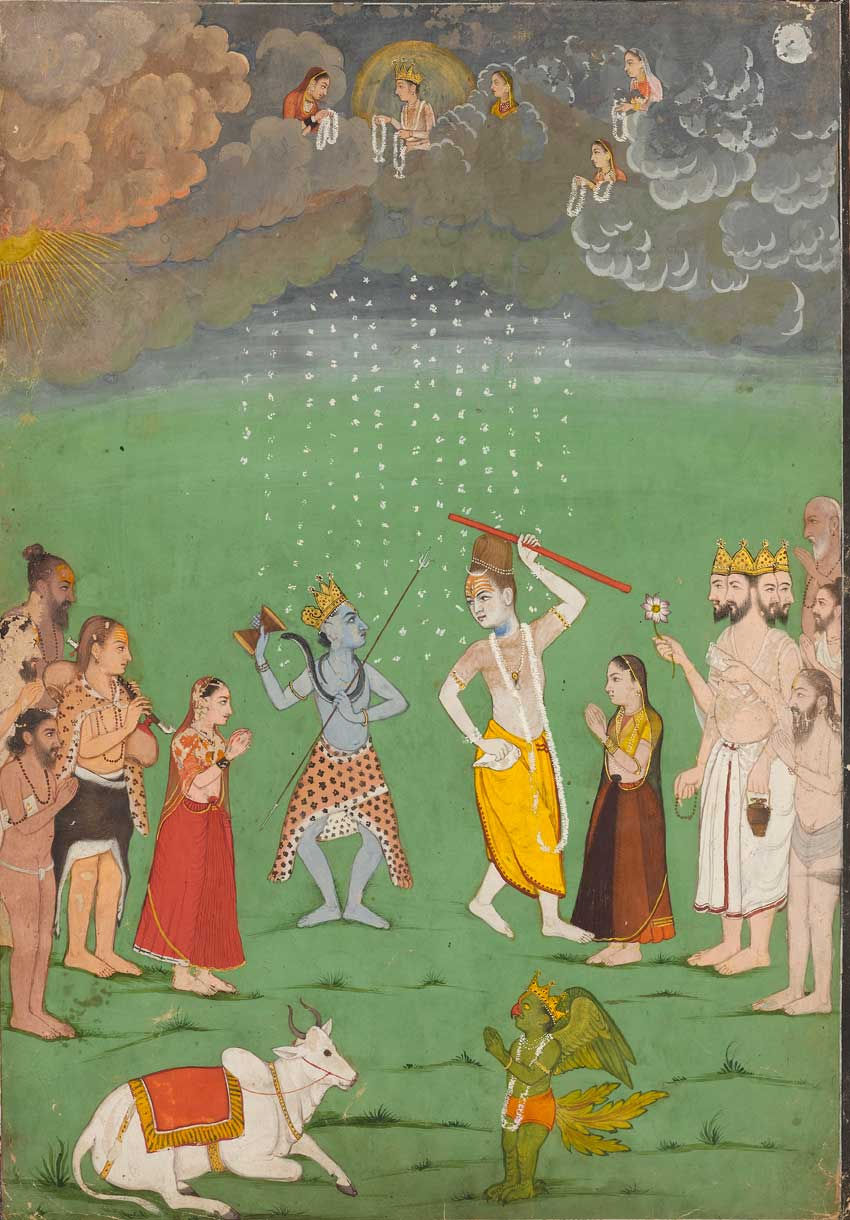
Fig. 1
The Gods Exchange their Attributes
By a Mandi artist, 1650-75
Private collection
Published in Losty, J.P., Paintings from the Royal Courts of India, Francesca Galloway, 2008, cat. 34
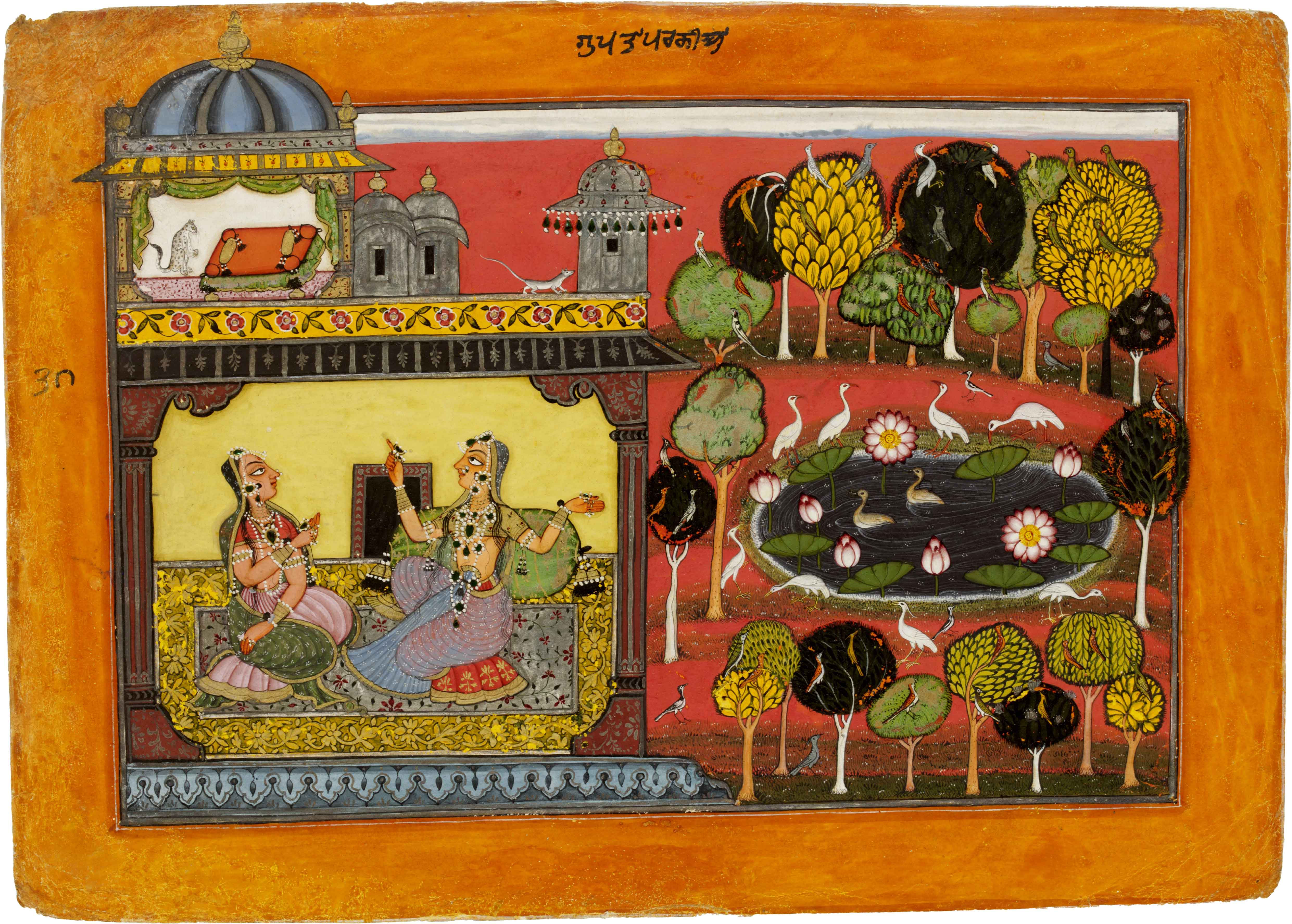
The Lady who blames the Cat for Scratches inflicted by her Secret Lover
‘Early’ Rasamanjari series of c. 1660–1670
© Victoria and Albert Museum, London (inv. IS.20-1958)
The lower hill states were incorporated into the Mughal empire and some of their rulers were required to attend court and to perform military duties, such as Raja Jagat Singh of Nurpur who was closely allied to Jahangir, so why, we wonder, did some states such as Mandi and Bilaspur produce Mughalised paintings and others including Nurpur and Mankot traditional Rajput ones? We do not have firm answers to these questions, but we can see the results later in the century.
Despite its close involvement with the Mughals, Nurpur kept stylistically aloof from the Imperial style, and its family of artists (connected with Devidasa of Nurpur) spread their influence to neighbouring states such as Basohli. Several dispersed Ragamalas connected with this artistic family epitomises its brilliantly coloured conceptual style (fig. 3).
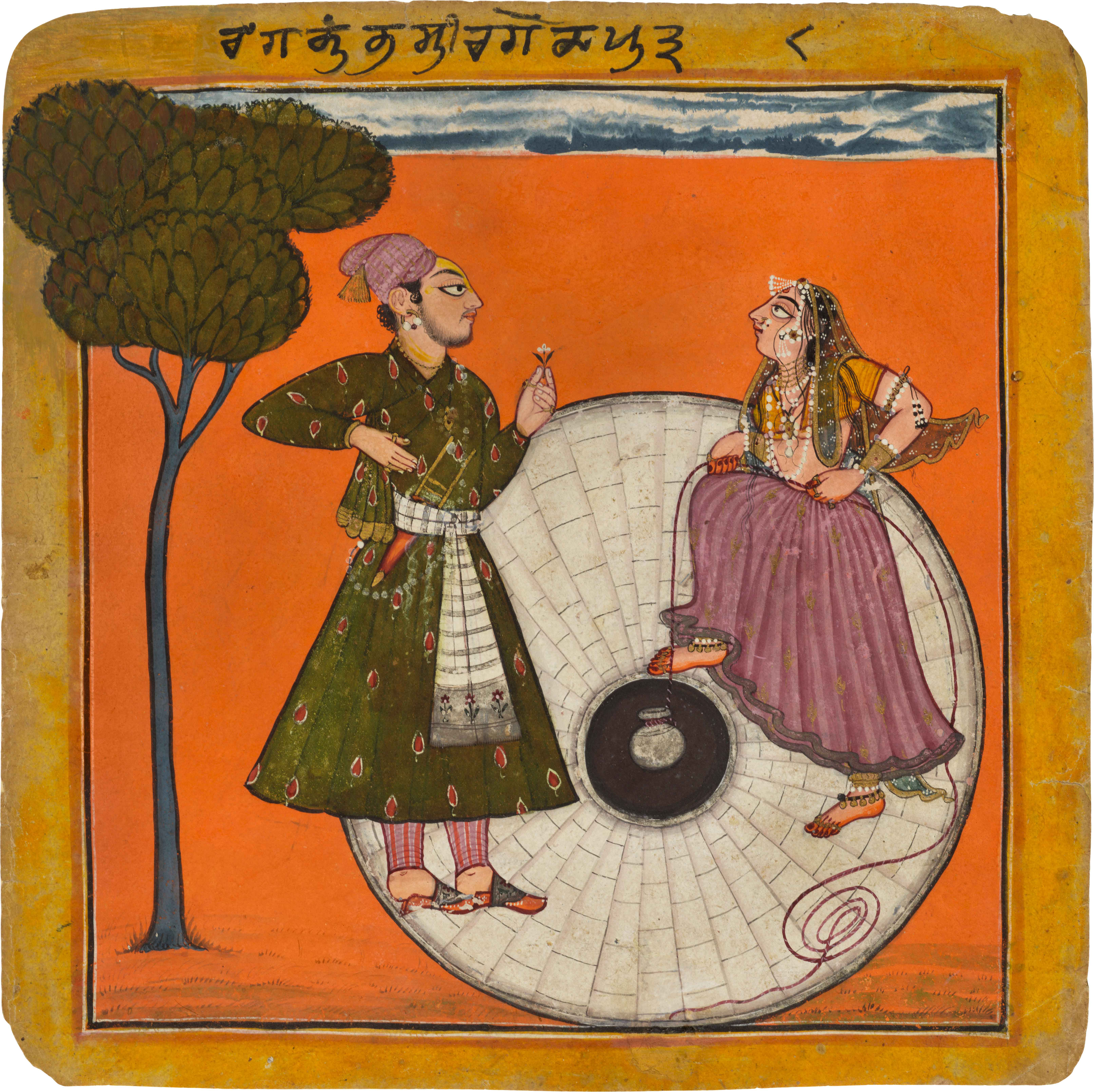
Fig. 3
Kumbha putra of Shri raga - Folio from a Ragamala series
Basohli, c. 1690-95
Private Collection
Published in Losty, J.P., Paintings for the Pahari Rajas, Francesca Galloway, 2020, cat. 2
Pahari’s most enigmatic set of paintings is the great series known as the ‘Shangri’ Ramayana (figs. 4 and 5). In 1973, W.G. Archer first published folios from this extensive series, which he divided into groups based on their style. B.N. Goswamy and Eberhard Fischer further discussed this series in their groundbreaking exhibition and publication Pahari Masters, in 1992. In 2017 J.P. Losty observed that the wild extravagance of Style I in the ‘Shangri’ series came from the work of imported artists from Basohli or Nurpur. In April 2026, The Cleveland Museum of Art will open their highly anticipated exhibition Epic of the Northwest Himalayas: Pahari Paintings from the “‘Shangri’ Ramayana”.
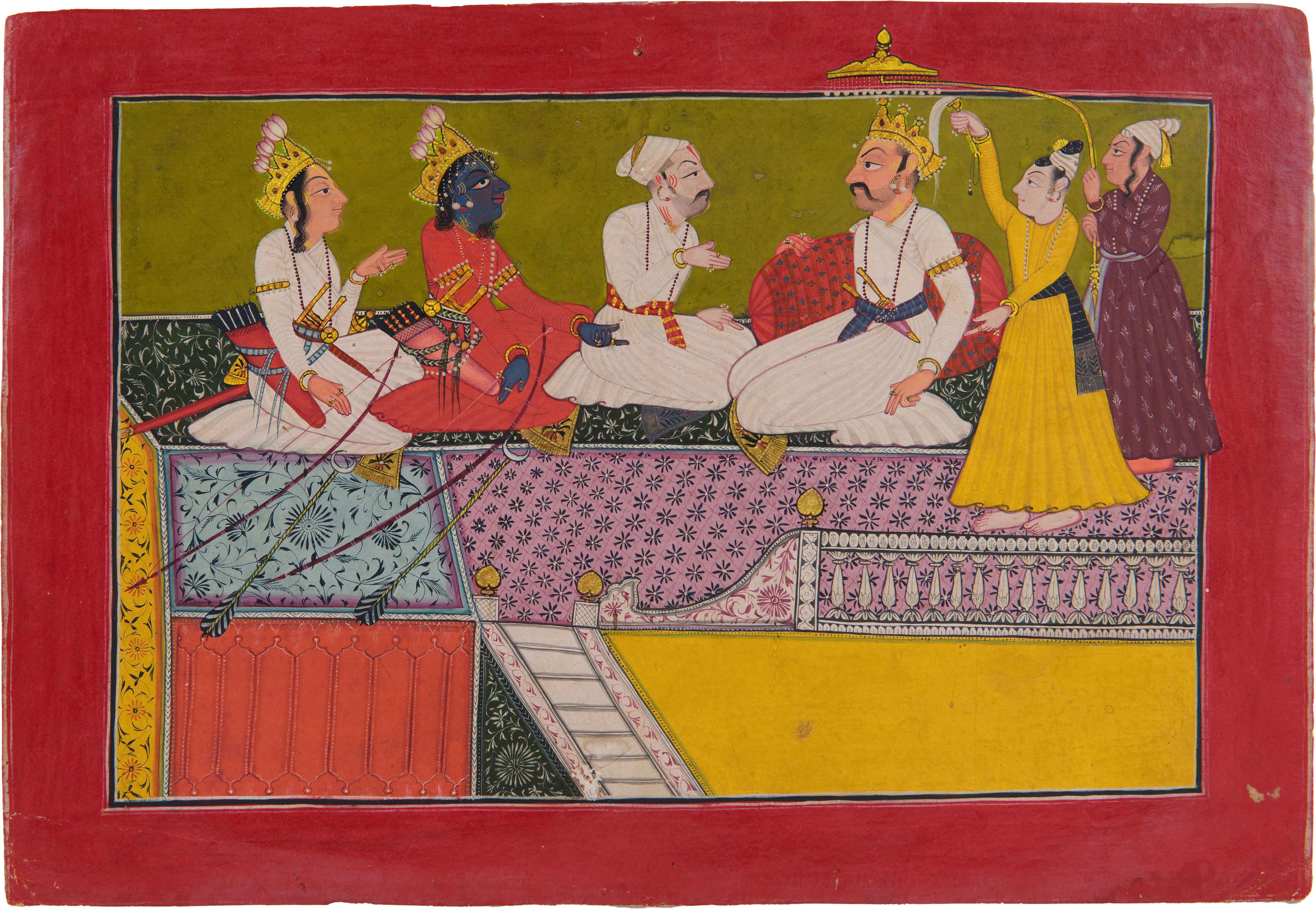
Fig. 4
Dasaratha Listens Attentively - Folio from the ‘Shangri’ Ramayana, Style I
Bahu (Jammu or Kulu), c. 1680–1700
Published in RARE: Indian Art for Court and Trade, Francesca Galloway, 2025, cat. 18
Further details available upon request
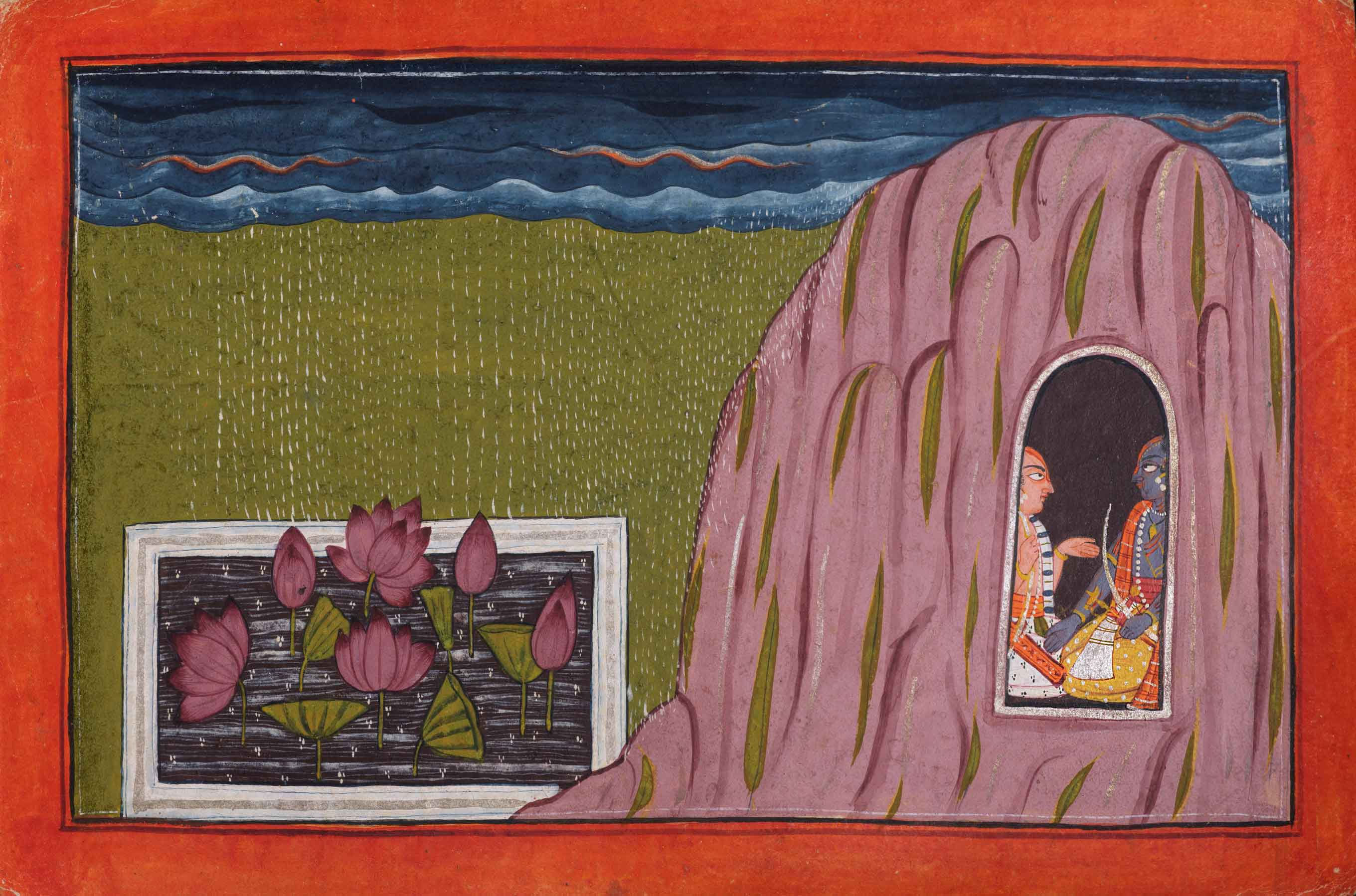
Fig. 5
Rama and Lakshmana Spend the Monsoon in a Cave on Mount Prasravana - Folio 115 from the ‘Shangri’ Ramayana, Style III
Bahu (Jammu or Kulu), c. 1700–10
Private collection
Published in RARE: Indian Art for Court and Trade, Francesca Galloway, 2025, cat. 21
These fairly wild and conceptual styles of the early 18th century continued in several other states such as Chamba, which specialised in Dashavatara sets of the ten avatars of Vishnu, Mandi and Mankot. The artist given the soubriquet ‘Master at the Court of Mankot, possibly Meju’ by Goswamy and Fischer in 1992 set the style at that court for three generations of artists. He and his workshop produced brilliantly conceptual portraits (fig. 6), iconographic studies, and also turned their hands to the illustration of equally magnificent versions of the Bhagavata Purana (fig. 7).
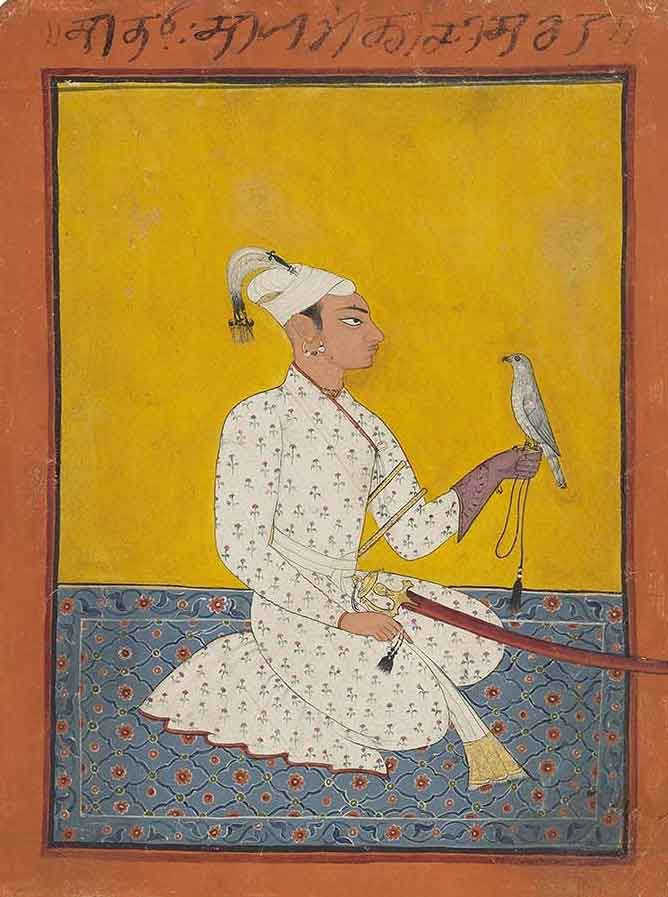
Fig. 6
A Prince with a falcon, perhaps Mian Kailashpat Dev of Bandralta
Bandralta or Mankot, attributed to the Master at the Court of Mankot or his circle, c. 1700–20
For more information, click here
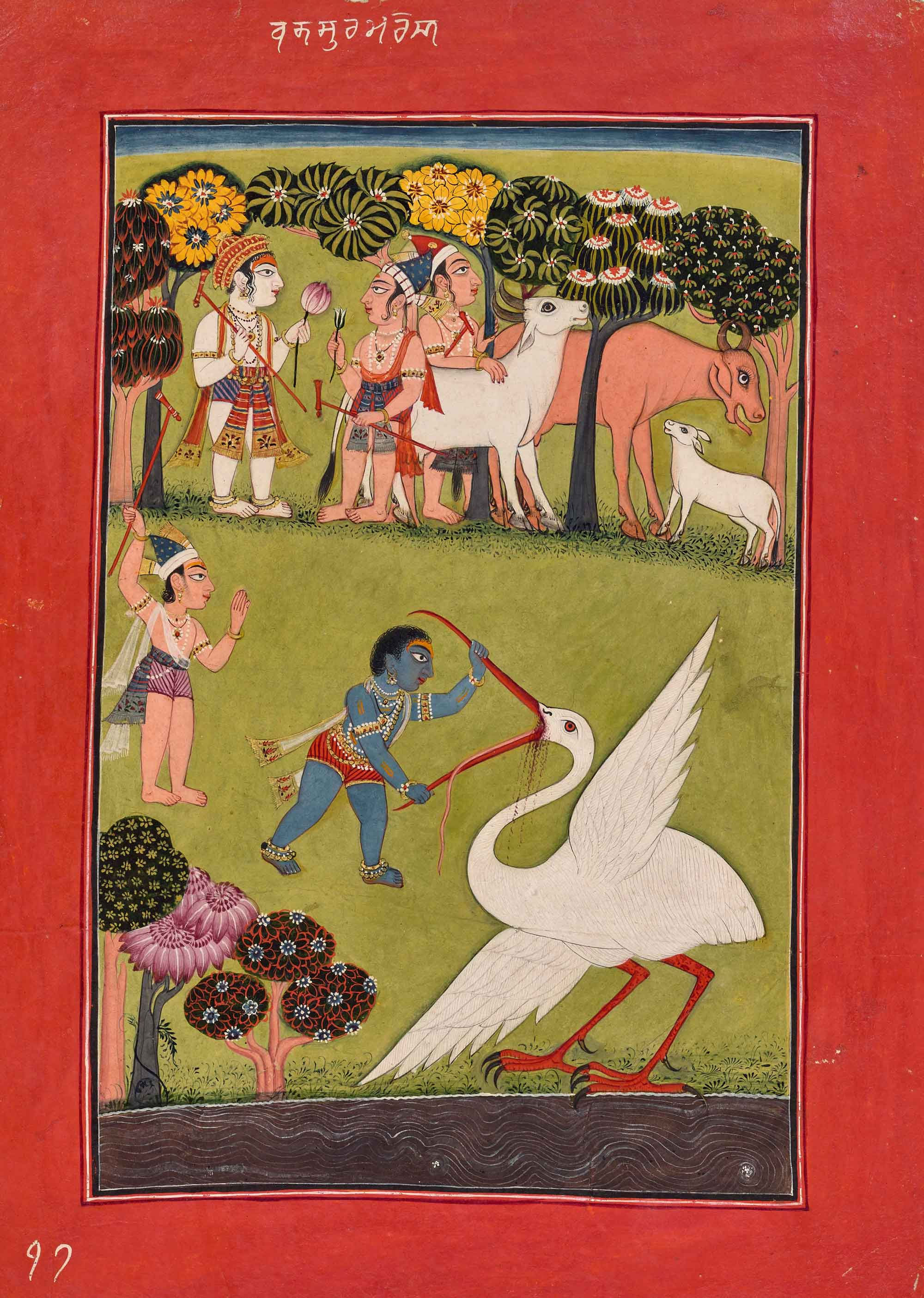
Fig. 7
Krishna kills the crane demon - Folio from the ‘Vertical’ Bhagavata Purana series
Attributed to the Master of the Court of Mankot, c. 1720
Minneapolis Institute of Art (The Driscoll Art Accession Endowment Fund 2020.5)
Published in Losty, J.P., Paintings for the Pahari Rajas, Francesca Galloway, 2020, cat. 9
After the 1720s, however, artists began to control such extravagances in the interests of producing calmer and subtler works of art. We can sense a growing influence of the Mughal style from the court of the Emperor Muhammad Shah (r. 1719-1748) on the styles of the hills, in particular that of Guler, a small state that hitherto seems to have had no noticeable artistic tradition. It is here that one of the most important artistic family dynasties in the Pahari region emerges. Goswamy and Fischer in 1992 demonstrated an unbreakable artistic and familial connection between Pandit Seu of Guler in the 1720s, his sons Manaku and Nainsukh in the period 1730-60, and their six sons in the next generation, whom they have termed the ‘First generation after Manaku and Nainsukh’.
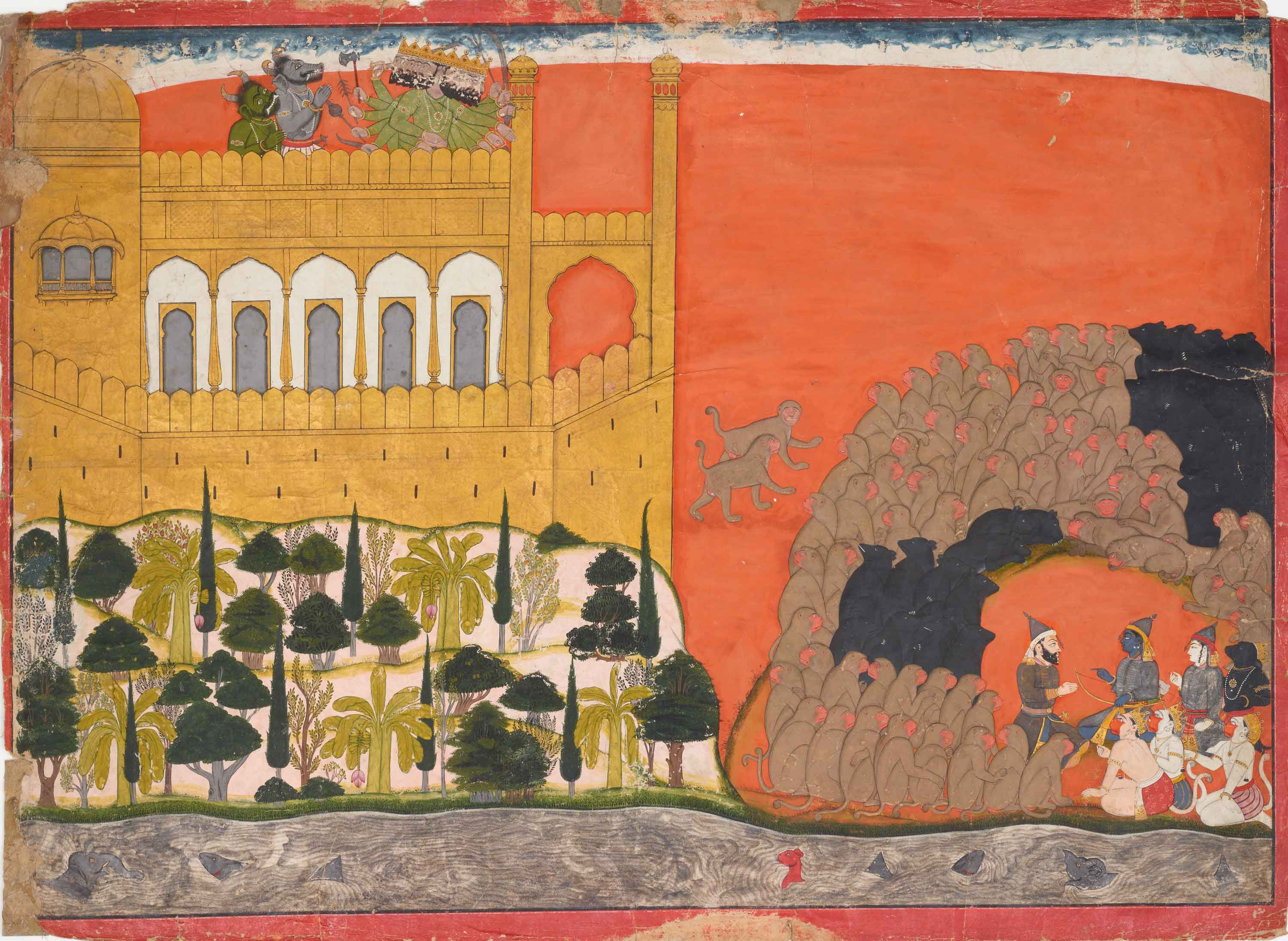
Fig. 8
Two Spies disguised as Monkeys approach the Army of Rama – Folio from the large-formatted Siege of Lanka Series
Manaku of Guler, around 1725
Permanent loan from Eberhard and Barbara Fischer, Museum Rietberg Zurich © Rainer Wolfsberger, Museum Rietberg
Whether or not Pandit Seu and his sons Manaku and Nainsukh had visited Delhi, all three artists incorporated Mughal features into their work, particularly of course in the case of the two sons. Manaku was a highly gifted and respected artist, though more conservative than his brother Nainsukh, and he was responsible for the monumental ‘Siege of Lanka’ series c. 1725 (fig. 8), the Gitagovinda of 1730, and the ‘Small’ Bhagavata Purana series of c. 1740 (fig. 9).
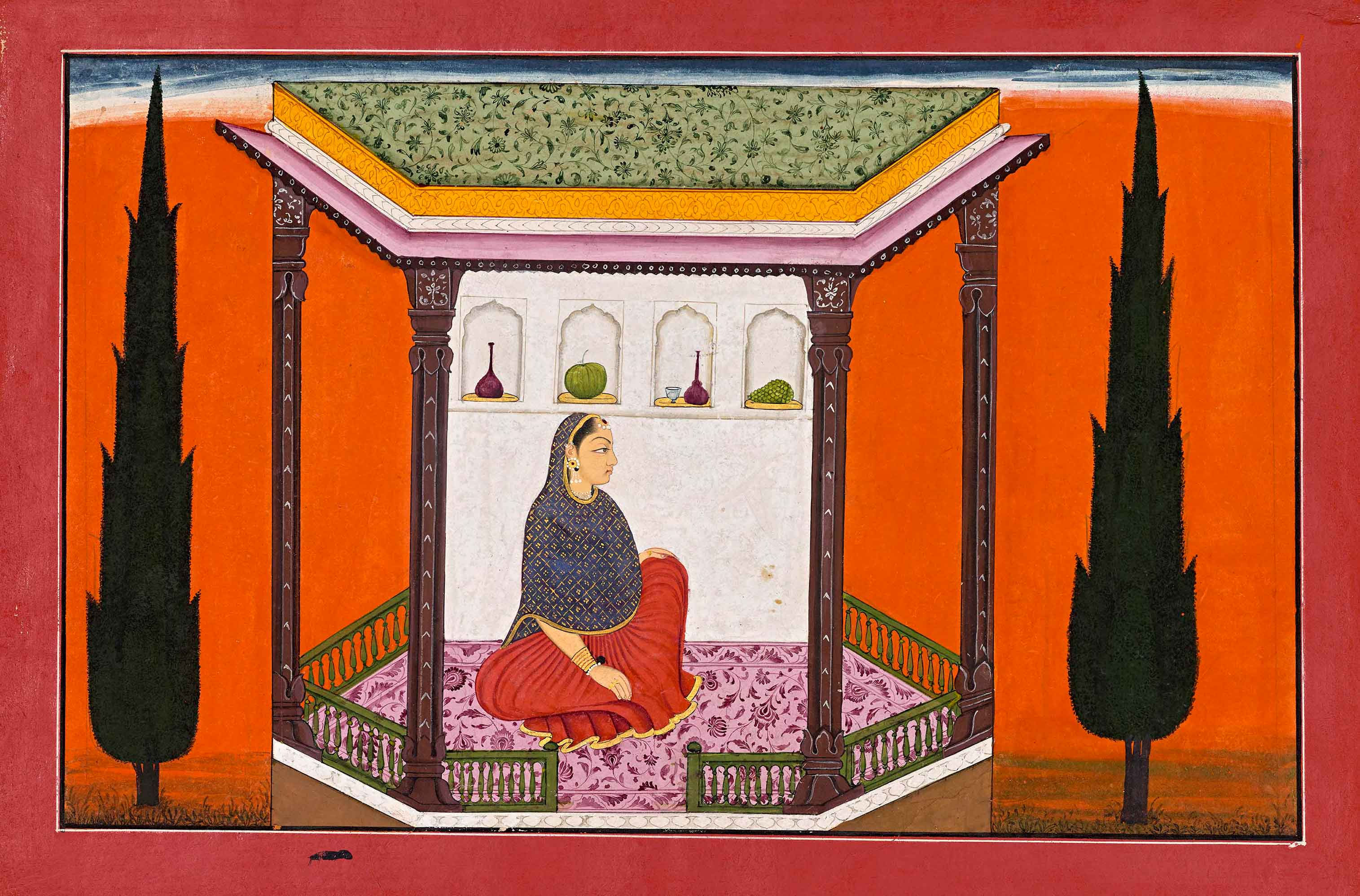
Fig. 9
The pregnant Diti contemplating her sorrow - Folio from the ‘Small Guler’ Bhagavata Purana series
Attributed to the Guler artist Manaku, c. 1750
Private Collection
Published in Losty, J.P., A Mystical Realm of Love: Pahari Paintings from the Eva & Konrad Seitz Collection, Francesca Galloway, 2017, cat. 4
It was Manaku’s younger brother Nainsukh who became the foremost and most innovative painter of his time. The luminous qualities of his work and the influence he wielded over the next generations, not only over his own family workshop but throughout the entire region, make him the most remarkable of the Pahari painters. Nainsukh was more interested than Manaku in Mughal portraiture and was able to incorporate many of its idioms, naturalism and immediacy into his own work after he took service with Raja Balwant Singh in Jasrota, who was to become his great patron. Much of the work he made for this Raja bears witness to idiosyncratic, keenly observed intimate moments within court life depicted with extraordinary insight and sympathy (fig. 10).
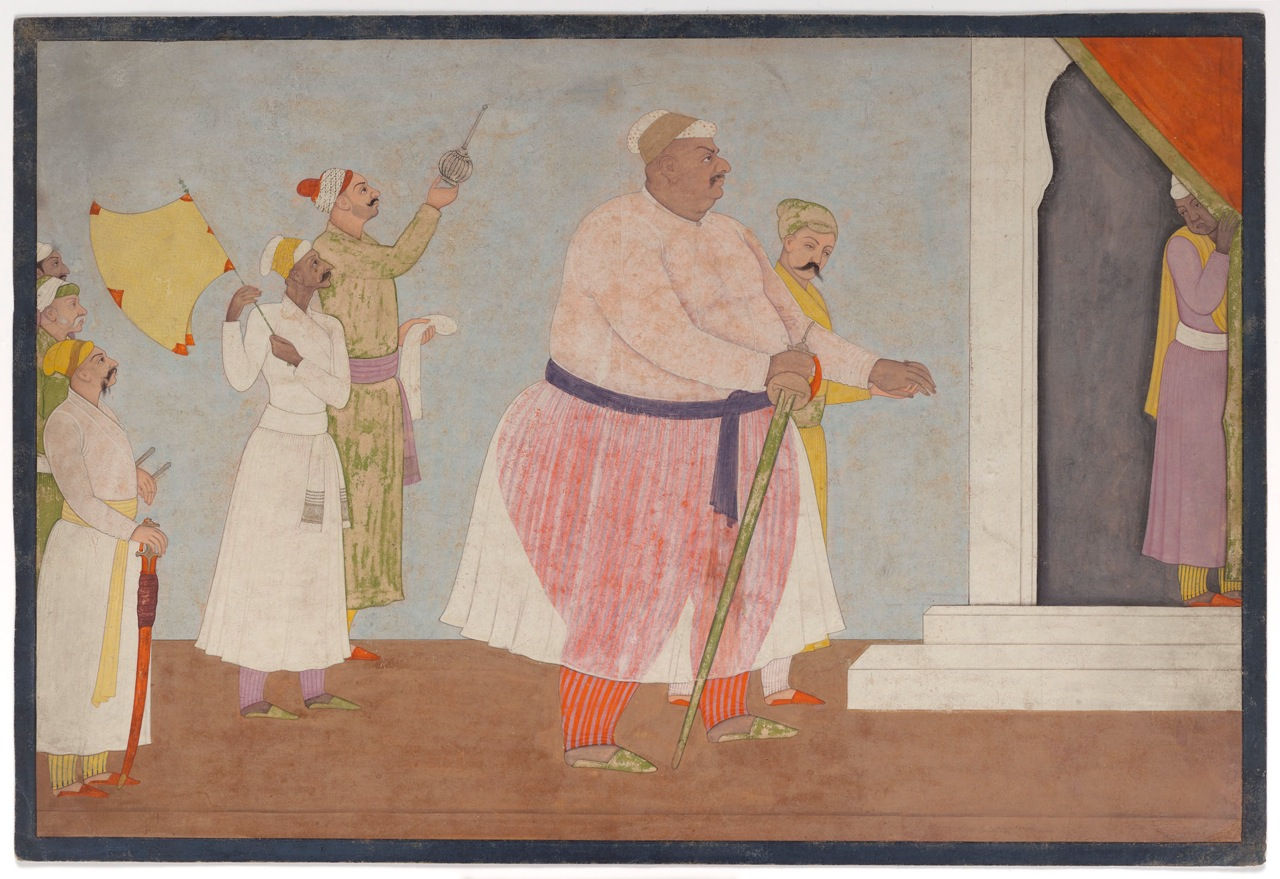
Fig. 10
An obese Raja being helped to cross a Courtyard
Jasrota, Attributed to Nainsukh, 1763-70
Private Collection
Published in Losty, J.P., The Divine and the Profane, Francesca Galloway, 2012, cat.1
After Balwant Singh’s death (in 1763), Nainsukh took service with his late patron’s nephew, Raja Amrit Pal of Basohli, and seems to have remained there until his own death in 1778. Here we come to one of the great cruxes of Pahari painting. What was Nainsukh doing during the fifteen years he worked for Amrit Pal from 1763-1778? Fewer than a dozen paintings have been identified as coming from this period. And what was his connection exactly with the next wave of Guler/Basohli innovation, the great manuscript series of the Gitagovinda, Bhagavata Purana and Ramayana, which have been conventionally dated 1775-80? The two problems are of course connected.
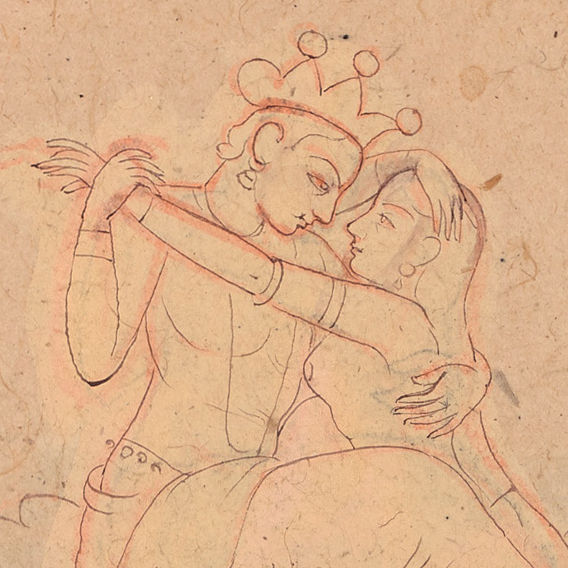
Fig. 11
Vishnu and Shri embracing - Drawing from a set of preparatory drawings for the ‘Second Guler’ or ‘Tehri-Garhwal’ Gitagovinda
Original outlines attributed to Nainsukh, c. 1765, with additions by his sons and nephews
Published in Losty, J.P., Paintings for the Pahari Rajas, Francesca Galloway, 2020, cat. 14
For more information, click here
Nainsukh was involved with the design of the compositions of the Gitagovinda seemingly from 1765, for the sanguine underdrawings are thought to be in his hand (fig. 11), which suggests that he began this work while working for Amrit Pal of Basohli. This was the ruler who accompanied his uncle Balwant Singh’s ashes to the Ganges at Haridwar in 1763 along with Nainsukh and either then or later the same year set off on a pilgrimage to Puri, on the eastern seaboard of Orissa, taking the artist with him. The god’s temple of Jagannath at Puri was the most important Krishna temple in the whole of India, and there Jayadeva’s Gitagovinda had been sung and danced to every day since the year 1499.
It is possibly the religious fervour instilled or awakened by such a sight that might have prompted Amrit Pal to commission an illustrated manuscript of Gitagovinda from his artist Nainsukh. Being unused to illustrating religious or poetic texts, Nainsukh set about the task after his return from Puri in about 1765, originating the concept and design with his red sanguine drawings. These were then worked on and painted by his sons and nephews – the so-called ‘First Generation after Manaku and Nainsukh’. One of only two scenes of action in this otherwise romantic series, shows Krishna slaying Kuvalayapida (fig. 12). The composition involves architecture and is original in its very high viewpoint.
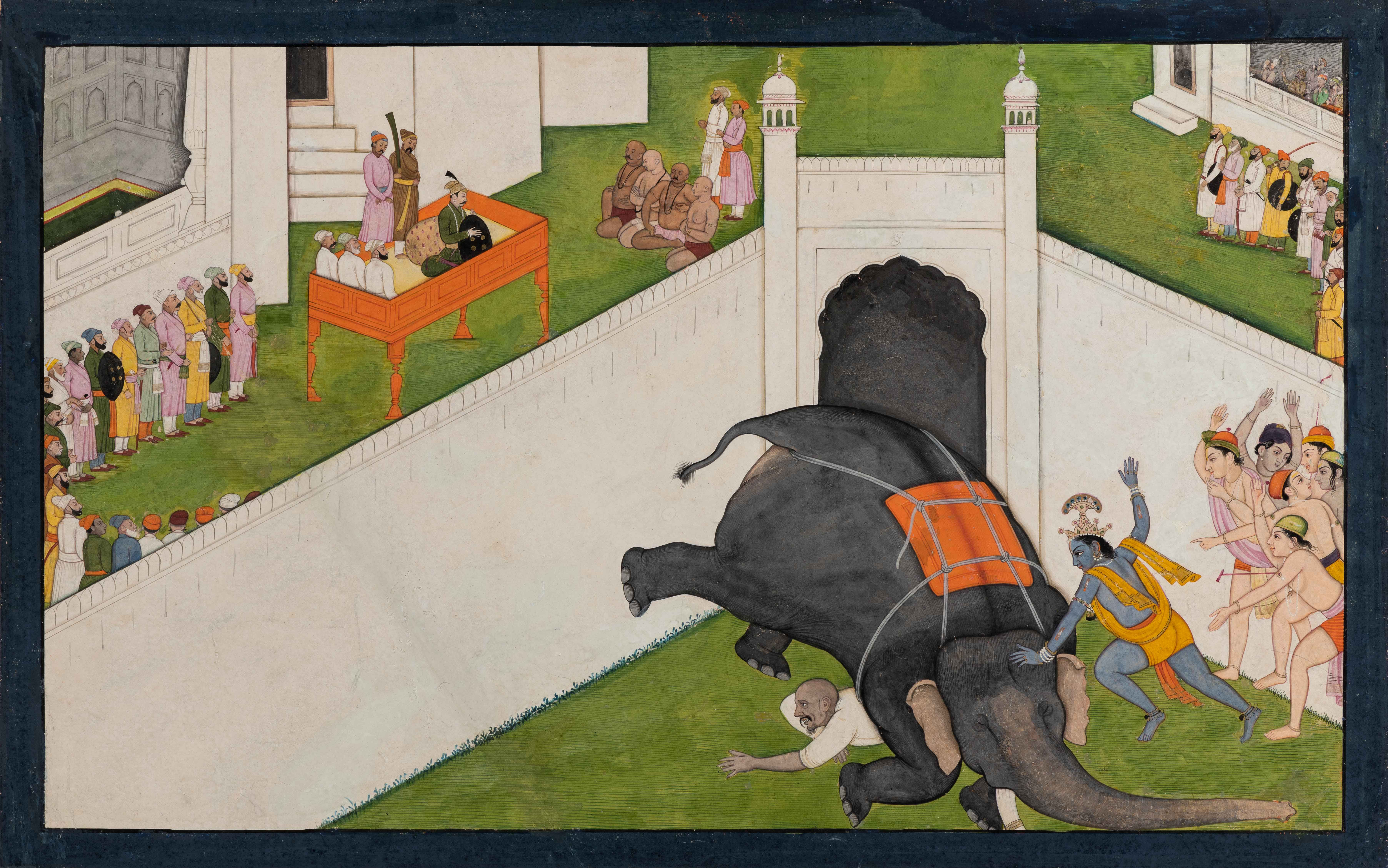
Fig. 12
Krishna slays Kuvalayapida - Folio from the ‘Second Guler’ or ‘Tehri-Garhwal’ Gitagovinda
Master of the first generation after Manaku and Nainsukh of Guler, 1765–70
Private collection
Published in Losty, J.P., Paintings for the Pahari Rajas, Francesca Galloway, 2020, cat. 16
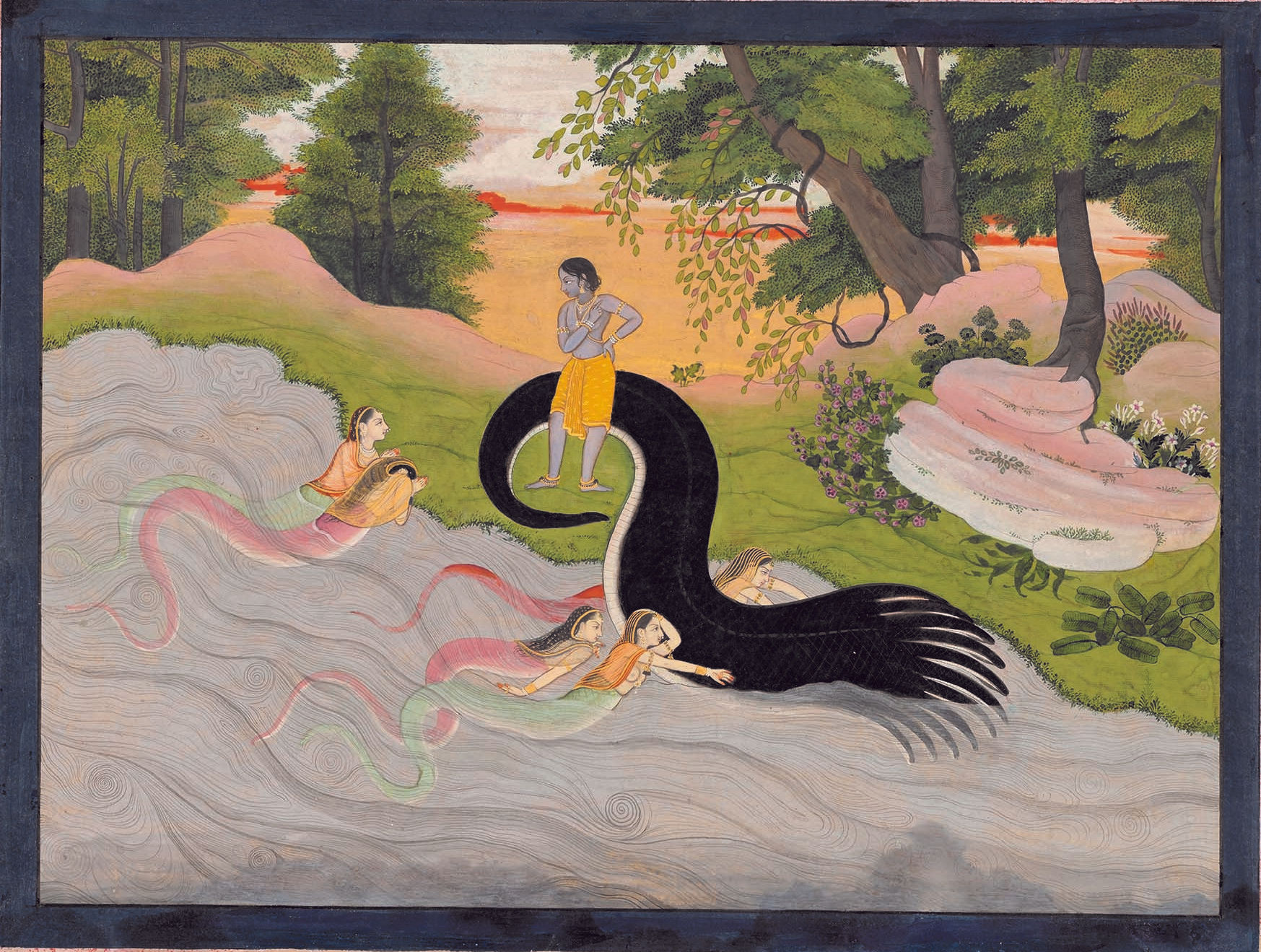
Fig. 13
The Wives of the Serpent-King beg a triumphant Krishna to spare their husband Kaliya -Folio from the ‘Modi’ Bhagavata Purana Series
By a Guler artist from the family of Nainsukh and Manaku, c.1770
Private collection
Published in Indian Miniatures, Textile Art, Francesca Galloway, 1994, cat.7
Losty brings the production of the Gitagovinda forward to1765-70, following on from the preparatory drawings conceived by Nainsukh in 1765. He also dates the Bhagavata Purana to c. 1770 (fig. 13) and finally the Ramayana to 1770-75 (fig. 14).
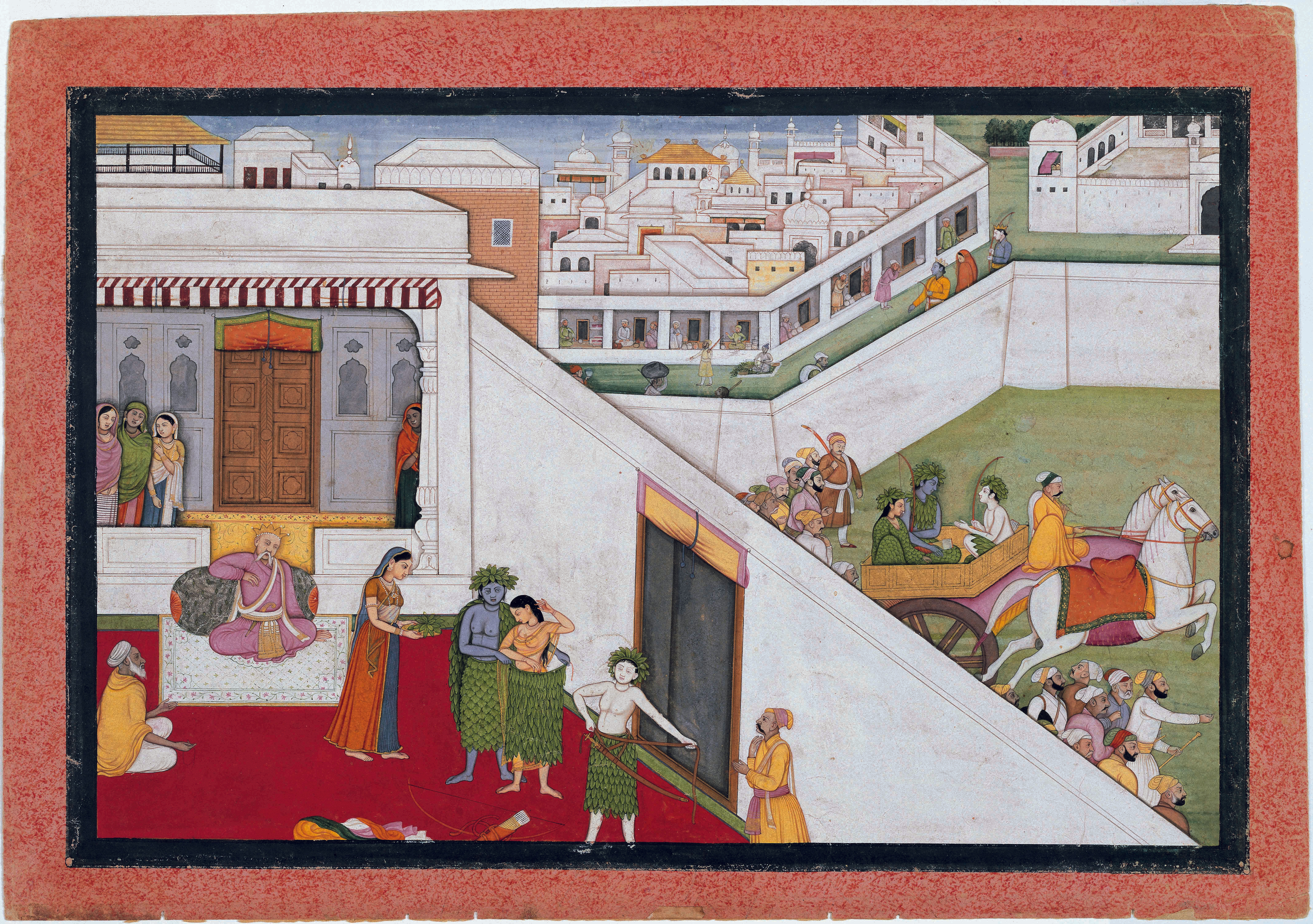
Fig. 14
Preparation for the Exile- Folio from Book II of a Ramayana Series
By a Guler artist, c. 1770–75
Museum Rietberg, A7, Gift of Ava and Konrad Seitz
Published in Losty, J.P., A Mystical Realm of Love: Pahari Paintings from the Eva & Konrad Seitz Collection, Francesca Galloway, 2017, cat. 19
The Ramayana was prepared in two campaigns. A second campaign involved Books V and VI, the Sundara- and Yuddha-kandas, which were completed somewhat later than the first three books, apparently over a longer period 1790-1810 (figs. 15 and 16).
Whether these manuscripts were prepared in Basohli for Amrit Pal by a team under the supervision of Nainsukh or whether his sons and nephews visited him from Guler and elsewhere to obtain guidance in the designs, it is impossible at the moment to say. The great patron Govardhan Chand of Guler was alive until 1773 and could have been involved in commissioning them along with his relative Amrit Pal. There are also the other series to consider done in this new style, the Ragamala, Baramasa, Satsai of Bihari, which is generally thought to be by Fattu (fig. 17), all of which we are dating here 1775-85. Other series such as the Sudama-charita, Usha-Aniruddha and the Rukminiharana seem linked to Chamba and to the presence of the third of Nainsukh’s sons, Nikka, at that court. Then there is the large series of Nala-Damayanti paintings and drawings.
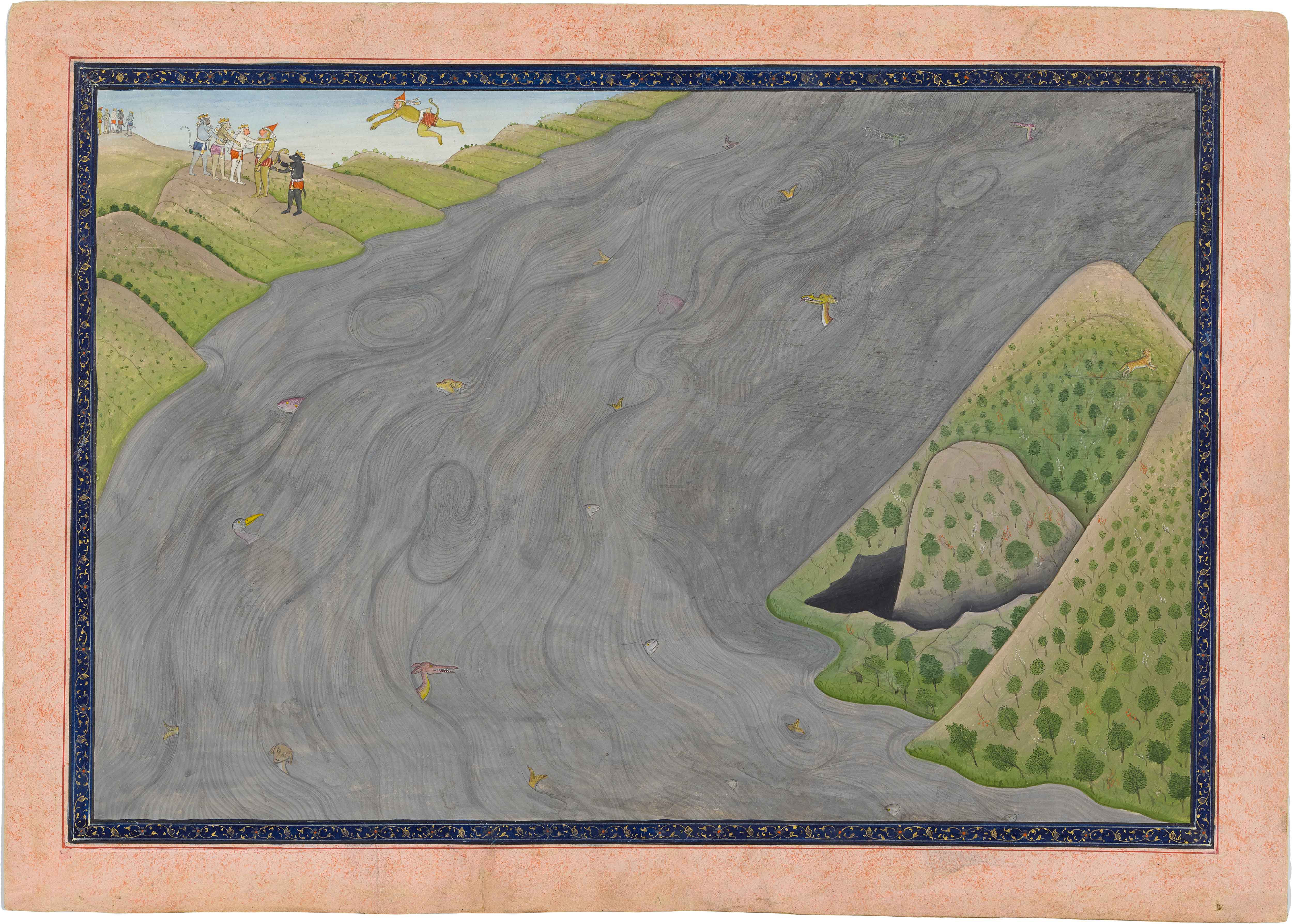
Fig. 15
Hanuman jumps back across the ocean from Lanka to Mount Mahendra
From book V of the ‘Second’ Guler’ Ramayana
By a Guler artist, c. 1800–10
For more information, click here
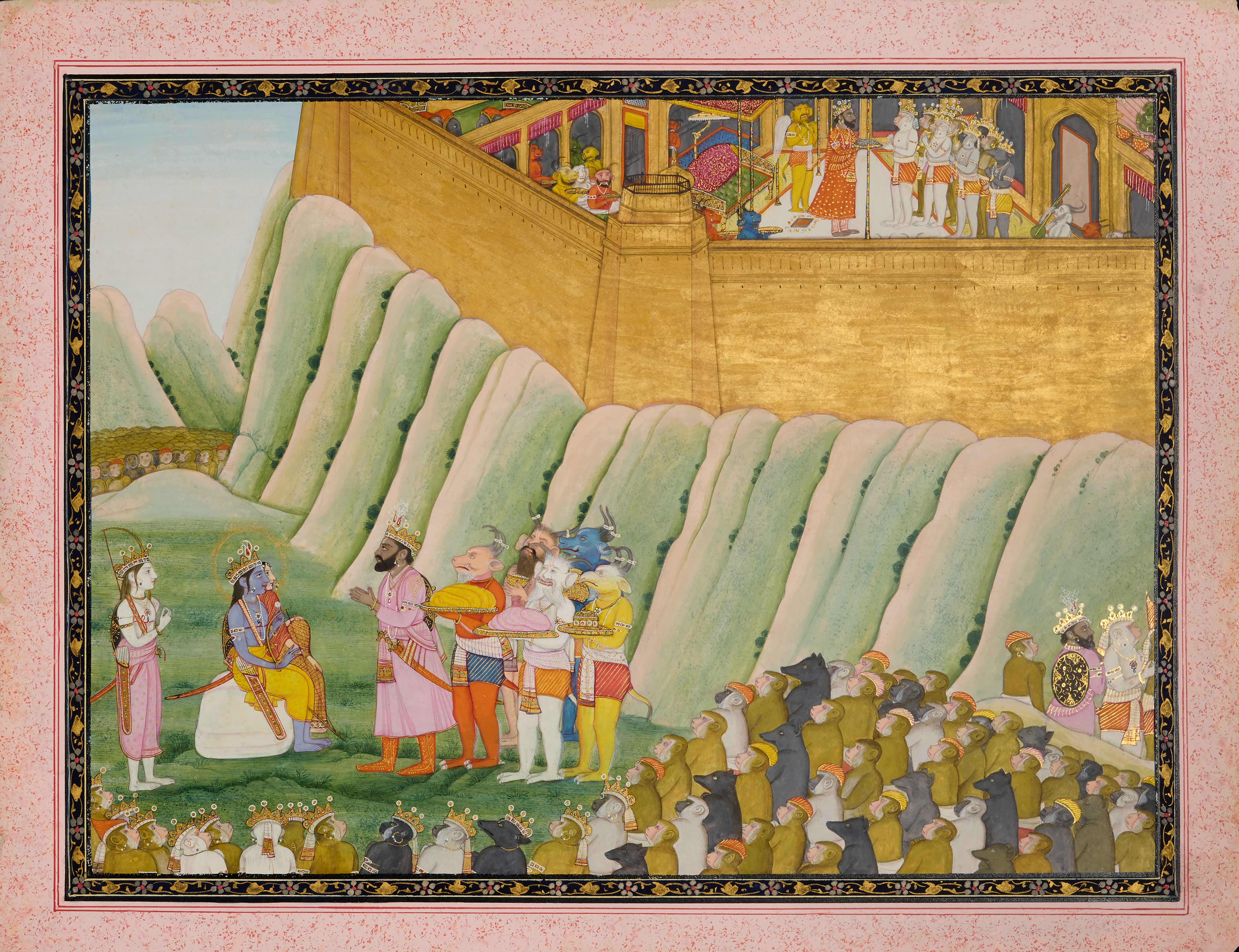
Fig. 16
Rama and Sita receiving gifts from Vibhishana, younger brother of the Demon King Ravana, and his Retinue of Demons
From Book VI of the ‘Second Guler’ Ramayana
By a Guler artist, c. 1800-10
For more information, click here

Fig. 17
‘Stay with me, my love’ - Folio from the ‘First Guler’ Satsai of Bihari
Attributed to the Guler artist Fattu, c. 1775
Private collection
Published in Losty, J.P., Paintings for the Pahari Rajas, Francesca Galloway, 2020, cat. 17
The six sons of Manaku and Nainsukh and their own sons spread the family style over the Hills from Jammu to Garhwal so the style that they all championed became the dominant artistic expression. The majority of surviving Pahari paintings fall into this post-1790 period.
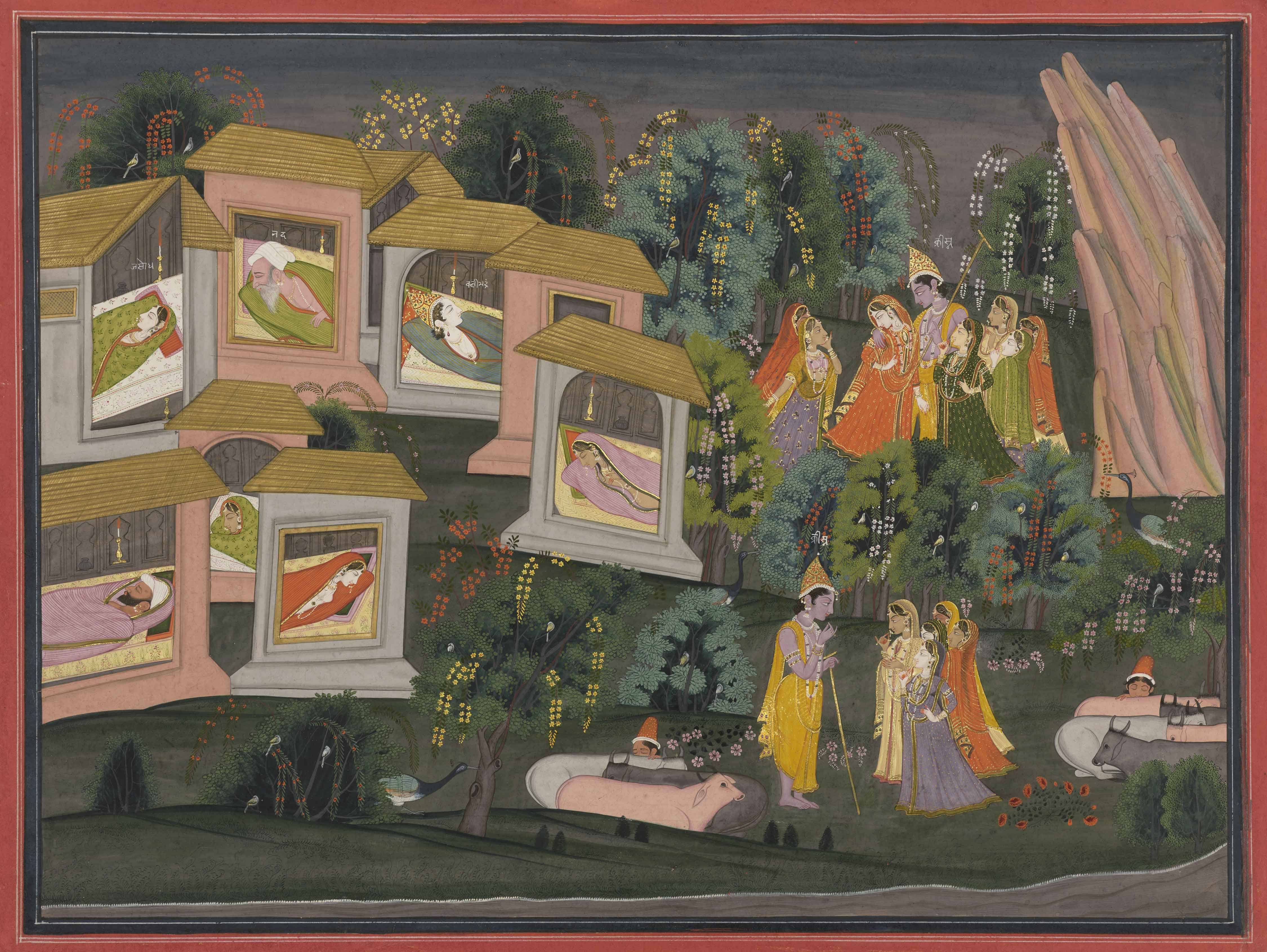
Fig. 18
Rasalila - Folio from a dispersed Harivamsha Series, numbered 86 on the reverse
Punjab Hills, Kangra, attributed to Purkhu, c. 1800-15
For more information, click here
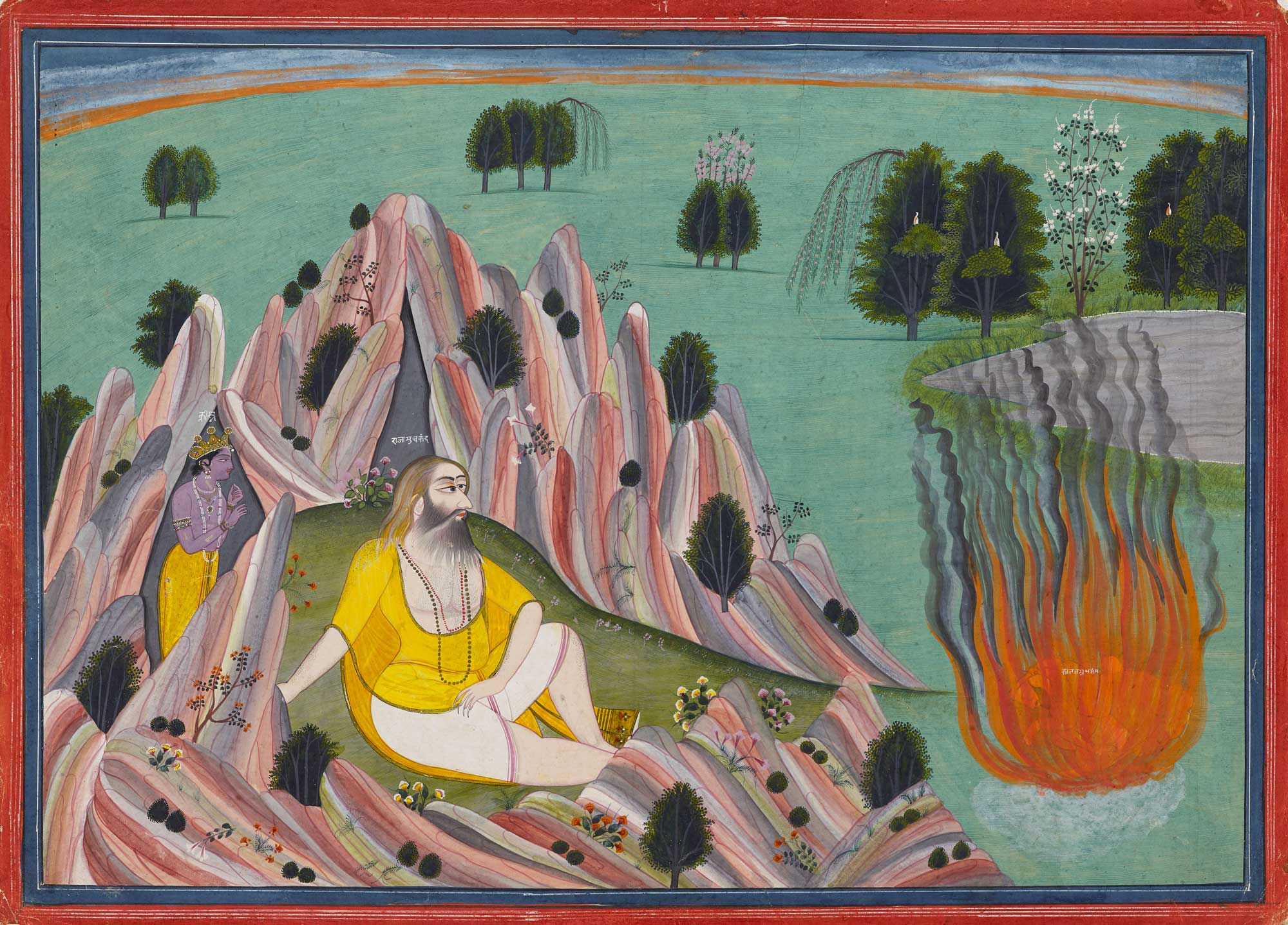
Fig. 19
Krishna lures King Kalayavana to the Cave of Muchukunda where he is burnt to Ashes - llustration from a Bhagavata Purana series
Kangra, attributed to Purkhu or his studio, c. 1820–25
For more information, click here
Purkhu in Kangra is an exception to the prevailing style. In the many religious and poetic works he painted for Sansar Chand of Kangra, we can see that Purkhu is less interested in say, the psychological insight we might expect of a portrait by Nainsukh, and more in the specific character and atmosphere of a particular scene, event, procession, festival, or the like. Seemingly unconnected architectural elements are used as elements of design, while in his Lambragaon Gitagovinda architecture is transplanted by lush forest, and nature celebrated with a rare and opulent abandon(figs. 18 and 19) . Goswamy and Fischer write of his unusual relationship with perspective, almost building his paintings “from the bottom up, in terms of scale, towards the most important figure, which is generally placed in the centre and rendered the largest”, so that almost a “reversed or inverted perspective” is created (Goswamy, B.N., and Fischer, E., ‘Purkhu of Kangra’ in Beach, M.C., Fischer, E., and Goswamy, B.N., Masters of Indian Paintings, Artibus Asiae, Zurich, 2011, p. 725).
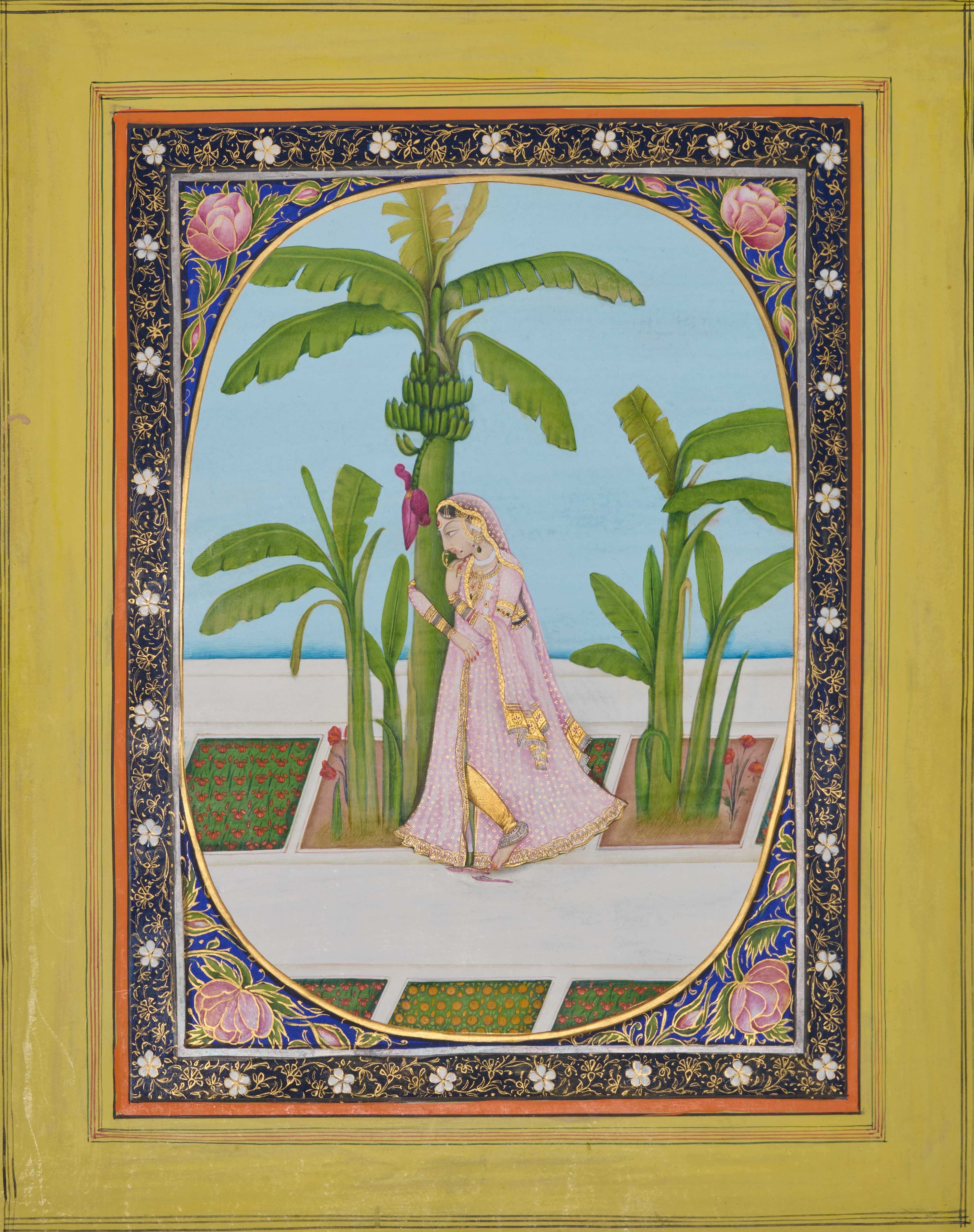
Fig. 20
A Disheartened Beloved
Mandi, attributed to Muhammadi, c. 1840
For more information, click here
This brief introduction has discussed some of the cruxes and significant developments in Pahari painting in the eighteenth century, but of course it was not downhill all the way after 1800. Patronage changed: first came the Gurkhas in occupation of much of the hills from 1805 until driven out by the Sikhs from the central and western hills in 1809. Then came the British in 1814. Many states now found themselves paying homage at the Sikh court at Lahore, or else only partly restored to their ancestral dominions by the British who took half of their kingdoms. Even with his diminished means Sansar Chand managed to commission a whole group of religious texts under the direction of Purkhu (see fig. 18 and 19), some of which had scarcely been illustrated before. Painting flourished for some decades at Mandi under Raja Ishvari Sen and his court artist Sajnu, and later on with the lesser-known Muslim artist Muhammadi (fig. 20).
Extract from J.P. Losty’s essay first published in Paintings for the Pahari Rajas, Francesca Galloway, 2020.